

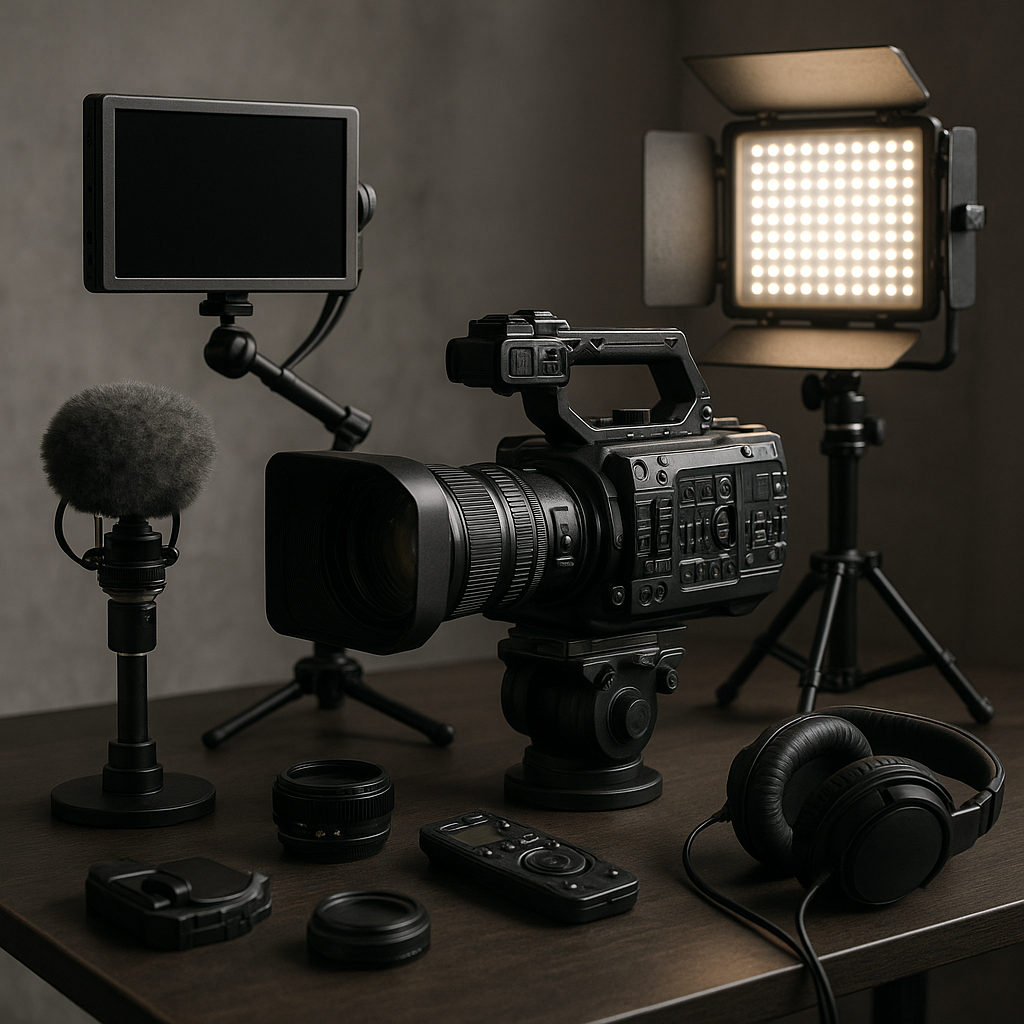
Look, I’ve been in this game for a while now… long enough to see people blow their entire budget on the wrong gear. And trust me, nothing kills a production faster than realizing you’re missing something crucial when the client’s already on set.
So let’s cut through the BS and talk about what you **actually need** to produce professional video content in 2025.
## The Camera (Obviously)
Okay yeah, this one’s a no-brainer. But here’s the thing – you don’t need the latest $50,000 cinema camera to create professional content anymore. Hell, some of the best corporate videos I’ve seen lately were shot on cameras under $5k.
What matters more? **Understanding your camera inside and out**. Whether it’s a Sony FX3, Canon R5C, or even a decent mirrorless… know your tool. Know it cold.
The real question isn’t “what’s the best camera?” It’s “what camera fits MY workflow?”
## Audio Gear (The Silent Killer)
I’m gonna be real with you. Bad audio will tank your production faster than anything else. People will forgive slightly soft focus. They won’t forgive audio that sounds like it was recorded in a tin can.
Here’s your non-negotiable audio kit:
– **Shotgun mic** (Rode NTG series or Sennheiser MKE 600)
– **Wireless lavs** (at least 2 sets)
– **Boom pole** (trust me on this one)
– **Audio recorder** (Zoom F6 or similar)
And please… PLEASE monitor your audio with headphones. Always.
## Lighting (Where the Magic Happens)
You know what separates amateur hour from the pros? Lighting. Period.
Start with:
– **Key light** (LED panel, at least 150W equivalent)
– **Fill light** (can be smaller, 75W)
– **Background light** (adds depth)
– **Light stands** (C-stands if you can swing it)
– **Diffusion** (softboxes, scrims, whatever works)
Don’t cheap out here. Good lighting transforms everything. Bad lighting? Well… let’s just say no amount of color grading will save you.
## The Stuff Everyone Forgets
This is where people screw up. They blow the budget on cameras and forget about:
**Tripods & Support**
– Rock-solid tripod (Manfrotto or similar)
– Fluid head (smooth pans are non-negotiable)
– Slider or gimbal for movement
**Storage & Backup**
– Multiple memory cards (always have spares)
– Portable hard drives (at least 2)
– Card readers that won’t bottleneck your workflow
**Power Solutions**
– Extra batteries (3x what you think you need)
– AC adapters
– Power banks
– Extension cords (longer than you think)
**The Little Things**
– Gaffer tape (not duct tape, GAFFER tape)
– Lens cleaning kit
– Color checker
– Clapperboard (yes, really)
– First aid kit
– Snacks and water
## Software (Your Post-Production Arsenal)
Look, gear gets you footage. Software turns that footage into a story.
Minimum setup:
– **Editing software** (Premiere, DaVinci Resolve, Final Cut)
– **Color grading capability**
– **Audio processing** (Adobe Audition or similar)
– **Graphics/motion** (After Effects for the fancy stuff)
## The Reality Check
Here’s what nobody tells you… having all this gear means nothing if you don’t know how to use it. I’ve seen people with $100k worth of equipment produce garbage because they didn’t understand the basics.
Start small. Master each piece before adding more. Build your kit as you grow.
And remember – your clients don’t care about your gear list. They care about results. About videos that move their audience, that tell their story, that solve their problems.
## Final Thoughts
Professional video production isn’t about having the most expensive toys. It’s about having the **right tools** and knowing how to use them.
Every production is different. Every client has unique needs. But with this foundation? You’re ready for pretty much anything.
Now stop reading gear reviews and go create something.
—
*Need help bringing your video vision to life? The team at Pivotal Moments Media has been producing killer content across Melbourne and Ballarat for years. They’ve got the gear, the know-how, and most importantly – they actually give a damn about your project.*
